
Myths About UV / LED Eyelash Extensions
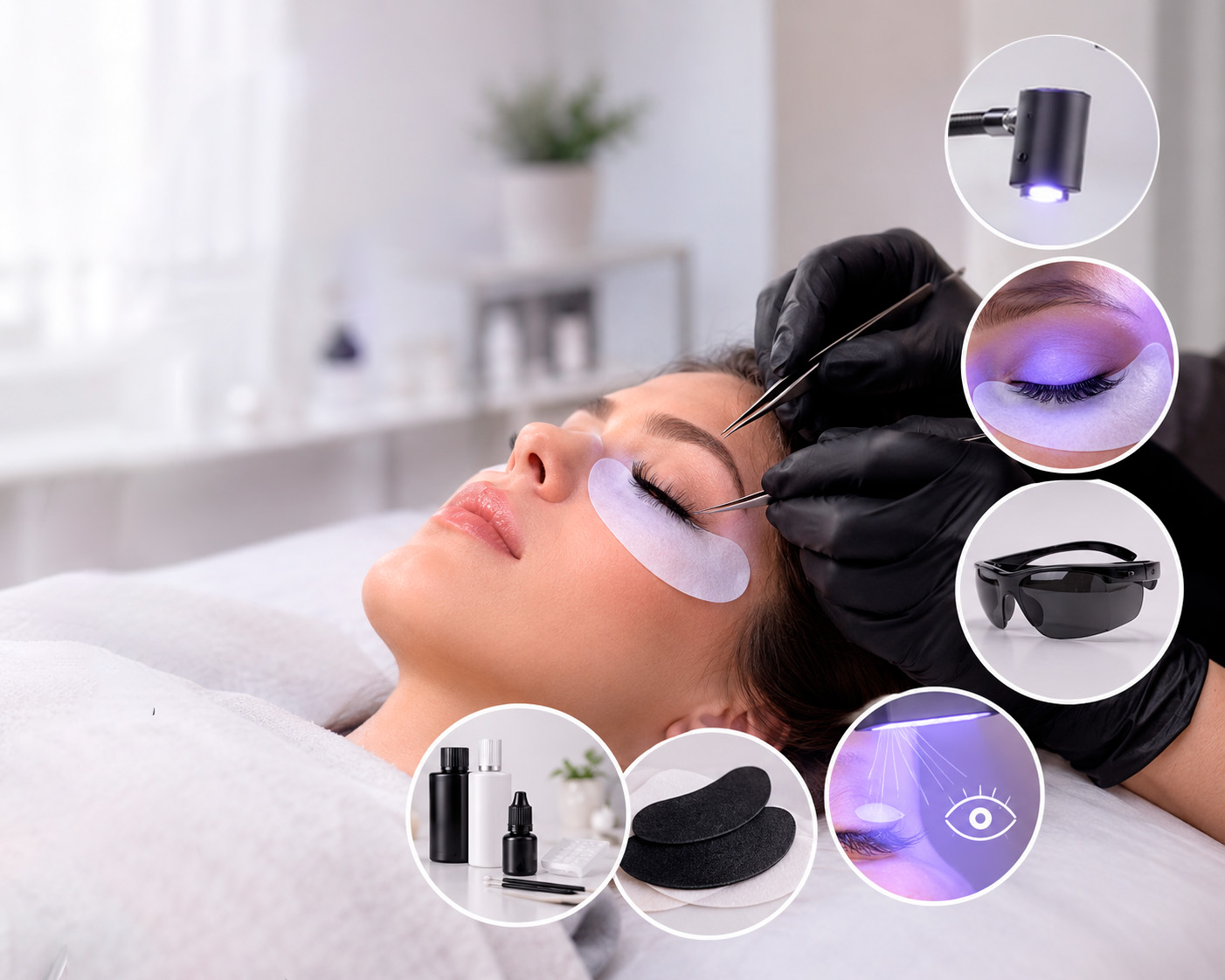
LED eyelash extensions are becoming increasingly popular. However, as interest in the technology grows, so does the number of myths surrounding it. Some people consider LED extensions completely safe and suitable for every client, while others are concerned about UV exposure and believe the procedure is more harmful than traditional eyelash extensions.
In reality, LED technology is neither “magically safe” nor inherently dangerous. What matters is understanding how the system works, which adhesive is used, what equipment is involved, and how carefully safety guidelines are followed.
Let’s take a closer look at the most common myths.
Myth 1. LED adhesive is completely hypoallergenic
This is one of the most common myths.
Using LED technology does not make an eyelash adhesive hypoallergenic. If the adhesive contains cyanoacrylate, the risk of an allergic reaction remains.
The adhesive used for LED eyelash extensions contains a photoinitiator that triggers polymerization when exposed to light. This makes the reaction more controllable and results in fewer fumes compared with traditional eyelash extensions. However, fewer fumes does not mean that there are no fumes at all.
Myth 2. LED eyelash extensions are completely safe for the eyes
LED eyelash extensions can be performed safely when the equipment is used correctly and appropriate safety procedures are followed. However, the statement that “LED is completely safe” is too absolute.
LED systems for eyelash extensions use light in the ultraviolet range close to the visible spectrum, typically around 395–410 nm. Safety depends on several factors, including the wavelength, lamp power, distance from the eyes, duration of exposure, and the design of the equipment itself.
Therefore, it is not enough to simply use a lamp labeled LED. The specifications of the equipment should be known, and the necessary documentation confirming its safety should be checked. The lamp should also be used according to the manufacturer’s instructions.
Myth 3. LED light damages eyesight
The fact that a UV range is used does not automatically mean that LED eyelash extensions damage the eyes.
Professional systems operate at much lower power than UV sources such as sunlight or tanning beds. During the procedure, the client’s eyes remain closed, and the lower eye area is additionally covered with patches that should block UV radiation.
However, this does not mean that any lamp can be used without restrictions. The specifications of the particular equipment must be taken into account, the recommended distance should be maintained, and appropriate protective measures should be used.
There is another important consideration. Some people may have increased individual sensitivity to UV radiation. This sensitivity can, for example, be affected by certain medications or products containing retinoids.
For this reason, the client’s individual characteristics and potential risk factors should be considered before the procedure.
Myth 4. With LED eyelash extensions, you no longer need to follow adhesive application rules
Fast polymerization does not replace professional technique.
An LED system allows the technician to control the timing of adhesive polymerization through light exposure. However, the natural lashes still need to be prepared correctly, the appropriate amount of adhesive must be used, and a proper adhesive bond must be created.
Note: We recommend using InLei® SALINE PRETREATMENT and Liquid Wrap Beautier to prepare the lashes for LED eyelash extensions.
It is also important to understand the difference between initial fixation and full strength development.
Even if the bond is fixed almost immediately after exposure to light, the adhesive may still need time to reach its maximum strength. This process can take around one hour or longer.
Therefore, “instant fixation” does not mean that all chemical processes inside the adhesive bond are completely finished at that exact moment.
Myth 5. LED allows you to work at any humidity and temperature
This statement also needs some clarification.
LED systems do reduce the dependence of the polymerization process on ambient humidity and temperature because polymerization is initiated by light.
Note: If you work in a room with strong natural light, the adhesive may polymerize even without the lamp because sunlight also contains UV radiation that can trigger the reaction.
However, this does not mean that the working environment no longer matters at all.
Different LED adhesives also have different characteristics. Their viscosity, working speed, and behavior during the procedure may vary.
Therefore, technicians should follow the recommendations of the manufacturer of the specific adhesive rather than relying on the general rule that “humidity and temperature no longer matter when using LED.”
Myth 6. LED eyelash extensions are suitable for absolutely every client
No.
Just as with traditional eyelash extensions, the condition of the natural lashes, the client’s individual sensitivity, contraindications, and the characteristics of the particular system must be taken into account.
LED eyelash extensions may also have additional contraindications related to UV exposure and individual sensitivity to UV radiation.
Myth 7. LED eyelash extensions are much faster than traditional extensions
Fast fixation is indeed one of the advantages of LED systems. However, the speed of the entire procedure depends on much more than the polymerization speed.
It is influenced by the technician’s technique, the speed of isolating natural lashes, adhesive handling, fan creation, and other stages of the procedure.
LED technology can therefore make the process more controlled and predictable, but it does not automatically turn the procedure into “one-hour eyelash extensions.”
Myth 8. LED adhesive always provides longer retention than traditional adhesive
This is another common exaggeration.
LED technology allows the technician to control the timing of polymerization and achieve stable fixation of the adhesive bond. However, this does not mean that every LED adhesive automatically provides longer retention.
The result depends on the quality of natural lash preparation, the accuracy of the bond, the amount of adhesive used, the characteristics of the adhesive itself, the technician’s technique, and the client’s aftercare.
For this reason, comparing retention simply as “LED versus traditional adhesive” is not accurate.
What is really important to know about LED eyelash extensions?
LED eyelash extensions are not a completely new method of eyelash extension. The main difference lies in how the polymerization of the adhesive bond is initiated.
The safety of the procedure, however, is determined by more than one factor. The equipment, adhesive characteristics and chemical composition, protective measures, and the technician’s technique all need to be considered together.
This is why LED eyelash extensions should not be evaluated based on a single statement such as “LED is safer” or “LED is more dangerous.”
With appropriate equipment and proper safety procedures, LED eyelash extensions are not necessarily more dangerous than traditional eyelash extensions. The main focus should still be on the adhesive, its composition, and the correct organization of the entire procedure.
LED technology gives technicians greater control over the timing of polymerization, but it does not eliminate the basic principles of professional eyelash extension work.